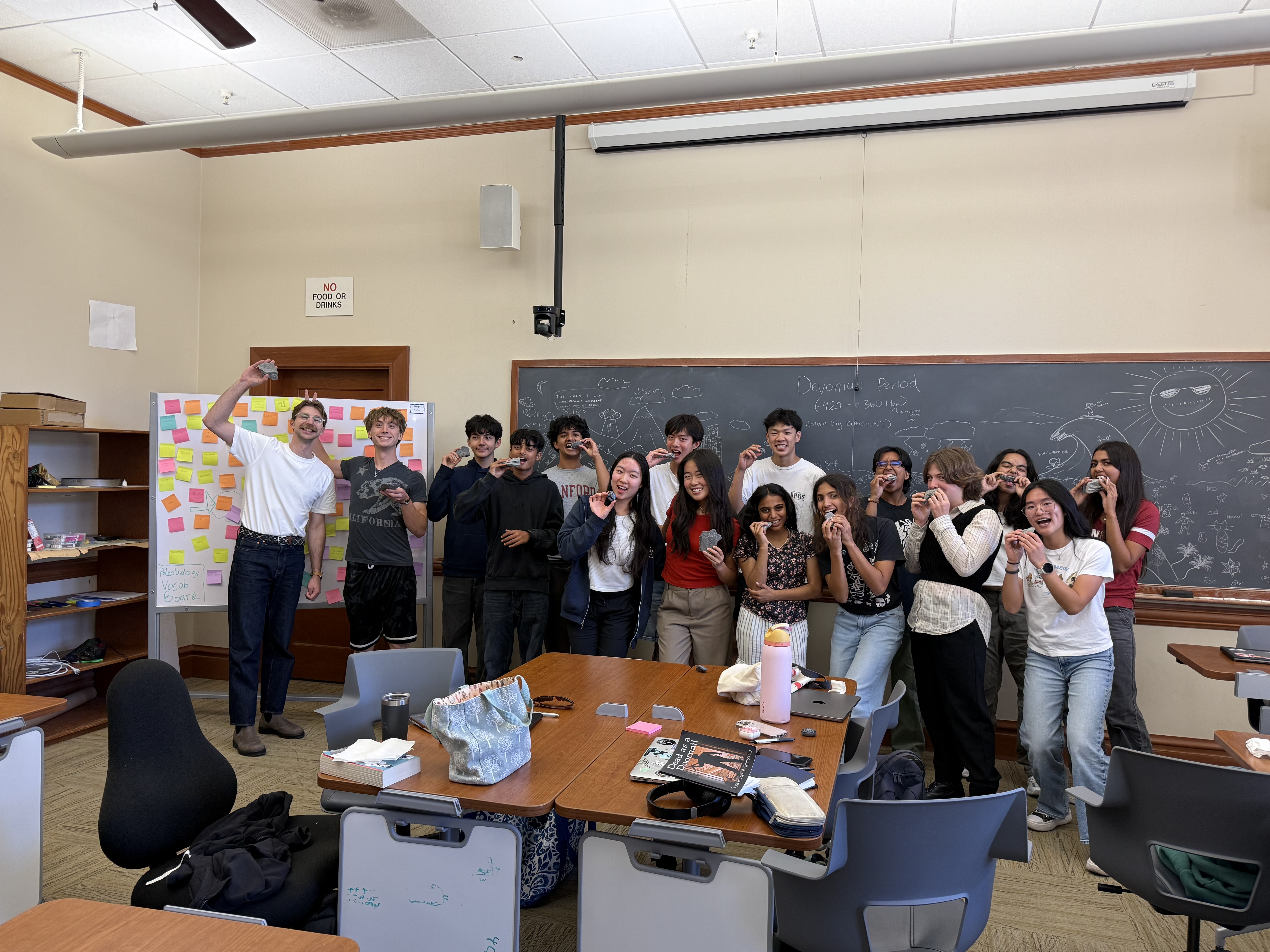
Currently, I lead the History of Life and Biodiversity (HOLB) group as a part of the Stanford Young Investigators summer internship program. HOLB is one-of-a-kind full-time, intensive, eight-week program that I designed from the ground up. It comprises 16 high school interns, focuses on paleobiology and Earth history, and combines classroom-based and experiential learning with genuine, collaborative research.
This program provides students the opportunity to gain knowledge and skills they could obtain nowhere else, while conducting a research project from beginning to end, including presenting their results at a conference.
My teaching involves

Classroom content

Hands-on learning

Field-based learning

Research and quantitative methods
History of Life and Biodiversity cohorts


Other teaching experiences

I have previously developed and taught a course on paleobiology as a part of the American Museum of Natural History’s Lang Science Program.
I have also developed and taught a graduate-level systematics lab course.

I have mentored dozens of students. In particular, I have helped many students conduct their first genuine research project (see “students’ conference abstracts” below) and navigate their way into/through university. Students I have personally mentored have been accepted into universities such as Harvard, Cornell, and Dartmouth


Mentoring is something I love and I am so grateful for all that my mentees have taught me and the unique experiences and perspectives they have exposed me to. I continue to mentor several students one-on-one.
Students’ conference abstracts
- Raoufi, A., Sanchez Perez, J, & Nikolic, M.C. 2026. Morphometric analysis of Elrathia kingii across collection sites in the House Range, Utah. American Geophysical Union Annual Meeting, San Francisco, CA.
- Gonzalez Sierra, K., Shenoy, A., Xiao, B., & Nikolic. M.C. 2026. Trilobite body-part assemblages across the House Range. American Geophysical Union Annual Meeting, San Francisco, CA.
- Amarnath, S., Leon, L., & Nikolic, M.C. 2026. Impact of collection-induced sampling bias on allometric interpretations in Elrathia kingii. American Geophysical Union Annual Meeting, San Francisco, CA.
- Burlingham, L. & Nikolic, M.C. 2026. Visual collection bias in Cambrian trilobites. American Geophysical Union Annual Meeting, San Francisco, CA.
- Menon, D. & Nikolic, M.C. 2026. Analyzing the morphology and size distributions of Cambrian agnostids. American Geophysical Union Annual Meeting, San Francisco, CA.
- Choong, K., Chu, A., Himatsingka, N., & Nikolic, M.C. 2026. Comparative study of Bolaspidella housensis ontogeny. American Geophysical Union Annual Meeting, San Francisco, CA.
- Kerrigan, A., Kumar, A., Lynch, J., Pourdehnad, A., & Nikolic, M.C. 2026. Measuring allometric growth of Elrathia kingii. American Geophysical Union Annual Meeting, San Francisco, CA.
- Kapavarapu, S. & Nikolic, M.C. 2025. Evolutionary Rates and Morphological Trends in Sessile and Mobile taxa Across Global Diversification Events. American Geophysical Union Annual Meeting, New Orleans, LA.
- Esguerra, S. & Nikolic, M.C. 2025. An Analysis of Taxonomic Diversity, Duration and Extinction Risk within Corals Through Current Living Organisms, and Previous Extinctions. American Geophysical Union Annual Meeting, New Orleans, LA.
- Schumacher, L. & Nikolic, M.C. 2025. A Resilient World: The Fossil Record Can Give Us Hope for the Future. American Geophysical Union Annual Meeting, New Orleans, LA.
- Helweg, A. & Nikolic, M.C. 2025. Studying The Effects of Environmental Stressors on Crabs Through Geologic Time May Help Predict Climate Change’s Impact on Future Marine Organism Traits. American Geophysical Union Annual Meeting, New Orleans, LA.
- Huang, M., Li, A., Nallu, V., & Nikolic, M.C. 2025. Implications of Fossil Evidence from Mass Extinction Events on Extant Marine Organisms. American Geophysical Union Annual Meeting, New Orleans, LA.
Connecting and communicating science with all members of the community, while making science more accessible is a core value of mine and I’m always keen for an outreach opportunity.
Some examples of outreach I have been involved in

Invited public talks
I have given several invited public talks for general audiences

Visiting NYC public schools
I have visited various public schools throughout NYC with fossiliferous rocks and rock hammers for them to break open rocks and find their own fossils.

Museum collection tours
I have given dozens of collections tours at the American Museum of Natural History and the Melbourne Museum. I have also taken museum collections to those that cannot make it in person to the museum (including kindergartens!)
Open Science, Collaboration, and Reproducibility in Paleontology
Palaeoverse workshop for the 2025 Paleontological Society Short Course.
All materials from this workshop can be found here
About this workshop
Since the development of large paleontological datasets from the 1970s onwards, paleontologists have increasingly adopted computational approaches to address questions about the history of life on Earth. This initiated a “Golden Age” of paleontology, where extensive datasets of various formats are used to test macroevolutionary and macroecological hypotheses. In parallel, the broader scientific community has been pushing for science to become more transparent, equitable, collaborative, and reproducible under the umbrella of “Open Science”. This culminated in 2023 being designated as the “Year of Open Science” by the White House Office of Science and Technology Policy. This short course will bridge these two movements to introduce the tenets of Open Science and how they can be incorporated into existing and future paleontological research workflows. First, we will provide an introduction to collaboration, version control, and data storage via services including Git, GitHub, Zenodo, and FigShare. We will then build upon this foundation by exploring the R programming language. R is one of the most popular languages in the world of data science and has been widely adopted by the paleontological community to clean, analyze, and plot data. General familiarity with R allows users to expand the potential of their research and automate routine tasks. We will introduce a suite of R packages that have been designed to standardize and streamline various parts of paleontological workflows (e.g., data cleaning). As part of this, we will briefly introduce existing paleontological databases (e.g., Paleobiology Database) and how they can be accessed from within the R framework. Finally, we will discuss the use of visualizations and how they can be efficiently and effectively developed to increase the transparency and equitability of paleontological research. This short course will provide a great opportunity for attendees to work with different researchers and gain experience working collaboratively in R to generate reproducible research. Further, we hope that this short course will bring the community together to share resources, reach agreed standards, and improve reproducibility in paleontological research. We anticipate this short course will be of value to paleontologists of all career stages.